Multi-user (Remote replication)
With the power of Apache CouchDB, Drafft supports realtime multiuser sync to a remote database.
Every time a user make a change it will sync the changes to the remote server. Now each client will poll this server for changes in "Remote sync interval" seconds, merging the changes on their local database.
That’s why the lock/unlock mechanism was added. We can replicate in real-time, but with the condition that no 2 users are modifying the same item to prevent conflicts and data loss.
Requirements
- A couchdb server, with admin permissions. A dedicated server for drafft is recommended. The easiest way to get it running is using the official docker image
- Connectivity of each computer to the server.
- Each user should have a distinctive username
- Each user should enable the remote sync feature in the project settings, and input the server url and database name.
Setting up a Remote CouchDB Server for Drafft
Drafft supports remote synchronization with a CouchDB-compatible server. This guide walks you through deploying CouchDB using Docker, enabling CORS for browser access, and preparing your server for integration with Drafft.
To deploy CouchDB using Docker, follow these steps:
Step 1: Deploy CouchDB with Docker
Create a file named docker-compose.yml:
services:
  couchdb:
    image: couchdb:latest
    container_name: drafft-couchdb
    restart: unless-stopped
    ports:
      - "5984:5984" # (Optional) Expose CouchDB on port 5984
    environment:
      - COUCHDB_USER=admin
      - COUCHDB_PASSWORD=secret_please_change
    volumes:
      - couchdb-data:/opt/couchdb/data

volumes:
  couchdb-data:

# Optional: Connect to the proxy network Instead of exposing ports
networks:
  default:
    name: proxy-net
    external: true
💡 Drafft recommends using a Docker volume for persistence. For advanced users, a bind mount may be used to access the database files directly.
Start the container:
docker compose up -d
This will launch CouchDB internally on port 5984, connected to your existing Docker reverse proxy network (e.g., with Nginx Proxy Manager).
Step 2. Set Up Reverse Proxy (Optional)
If you're using Nginx Proxy Manager (or Caddy, etc.), point a subdomain like couch.drafft.dev to the internal service drafft-couchdb:5984.
- Ensure ports 5984 are not exposed publicly.
- Use HTTPS for production.
Ensure client_max_body_size is set high enough in your reverse proxy to accommodate large document uploads. Otherwise you may encounter errors when syncing large files (413 Request Entity Too Large).
Step 3. Enable CORS for Browser-Based Access
To allow Drafft to sync from a browser, enable Cross-Origin Resource Sharing (CORS):
This is can be done via the CouchDB Admin UI. For advanced users, you can also use the command line.
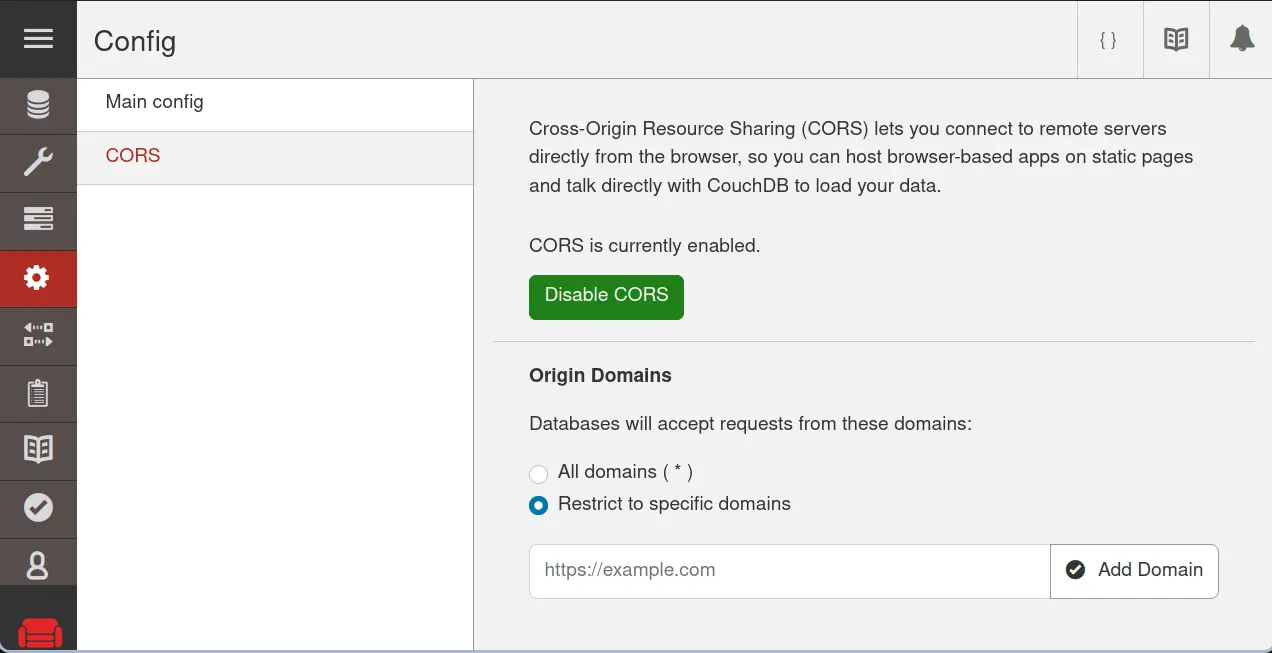
Restart CouchDB
docker restart drafft-couchdb
Access CouchDB Admin UI
You can access the CouchDB Admin UI at http://localhost:5984/\_utils or via your reverse proxy URL (e.g., https://couch.drafft.dev/_utils).
Choosing How to Configure Remote Sync
Drafft supports two ways of setting up the remote CouchDB database. Choose the approach that fits your workflow and security requirements.
Option 1 — Easy Mode: Let Drafft Create the Database
If you use your CouchDB admin account, Drafft can automatically create the project database the first time you enter your sync settings.
Open:
Project Settings → Remote Replication → Sync with remote DB
Fill in:
- Server URL
- Admin username + password
- Desired database name
Drafft will:
- Check if the database exists
- Create it if it doesn’t
- Set basic permissions automatically
Small teams, prototypes, and setups where granular security is not required.
Option 2 — Advanced Mode: Create the Database & User Manually
If you prefer tighter control, don’t want users to rely on an admin account, or want to configure custom permissions, this method is for you.
You can follow these steps either through Fauxton or the CouchDB HTTP API.
1. Create a database
Example database name:
drafft_2_quantum_empanada
Fauxton: Create Database → drafft_2_quantum_empanada
HTTP API:
PUT /drafft_2_quantum_empanada
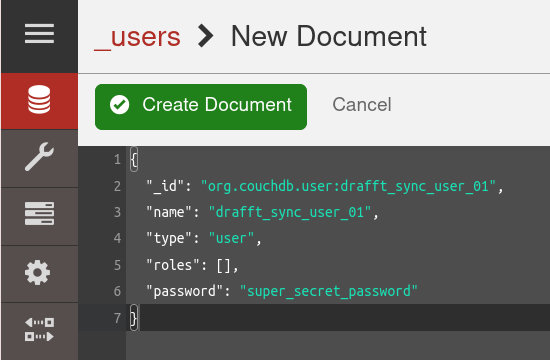
2. Create a dedicated database user
Fauxton: Database → _users → Create Document
Paste:
{
  "_id": "org.couchdb.user:drafft_sync_user_01",
  "name": "drafft_sync_user_01",
  "type": "user",
  "roles": [],
  "password": "super_secret_password"
}
HTTP API:
PUT /_users/org.couchdb.user:drafft_sync_user_01
Content-Type: application/json

{
  "name": "drafft_sync_user_01",
  "type": "user",
  "roles": [],
  "password": "super_secret_password"
}
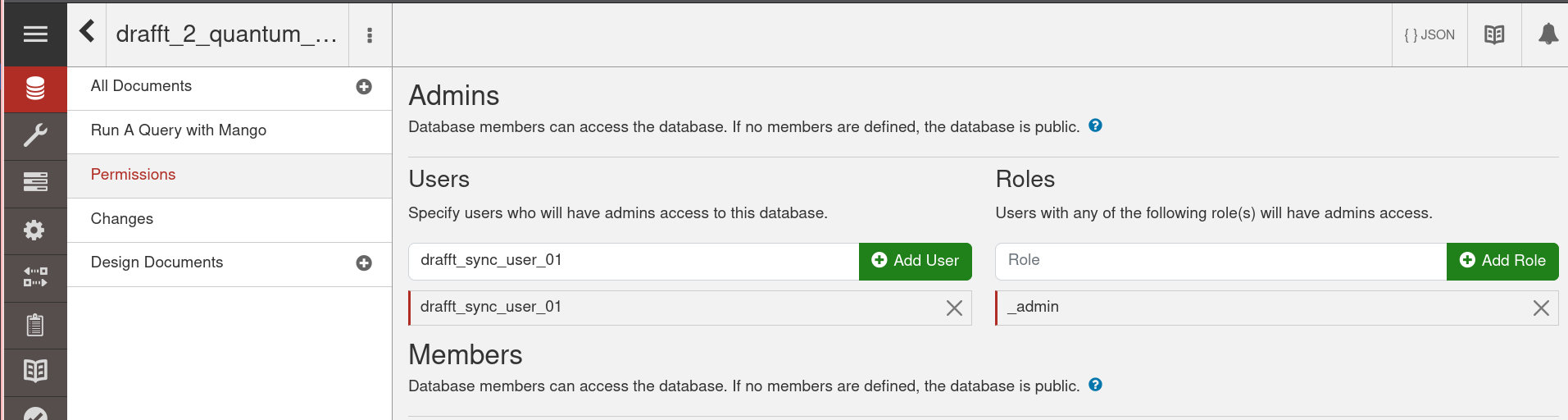
3. Assign permissions
Fauxton: Database → drafft_2_quantum_empanada → Permissions → Members → Add User
Add:
drafft_sync_user_01
HTTP API:
PUT /drafft_2_quantum_empanada/_security
Content-Type: application/json

{
  "members": {
    "names": ["drafft_sync_user_01"],
    "roles": []
  },
  "admins": {
    "names": [],
    "roles": []
  }
}
4. Configure Drafft
Open:
Project Settings → Remote Replication
Enter:
- Server URL
- Your created database name
- The restricted username + password
Drafft will sync using that user and will not attempt to create or modify any other databases.
Production systems, multi-project servers, and setups requiring least-privilege access.
Drafft Integration Requirements
Database URL:
- Must begin with http:// or https://
- Example: https://couch.drafft.dev
Database Name
Couchdb doesn’t allow capital letters so Drafft does not allow it either (when you create it uppercase the database name will be renamed to lowercase). It is better to avoid spaces and special characters in the name.
The database name must:
- ✅ Start with a lowercase letter
- ✅ Contain only lowercase letters, numbers, or the symbols _, $, (, ), +, -, /
- ❌ No uppercase letters, spaces, or special characters like @, !, etc.
Examples:
- ✅ drafft-sync
- ✅ user_data_01
- ❌ UserData (uppercase)
- ❌ user data (space)
- ❌ user@data (invalid character)
The database name must be unique for each project. If you try to sync a project with the same name as another one, it will try to sync with the existing database. potentially losing data and conflicting with other users.
Sync issues
Although the process is simple and it's quite tested, certain networking conditions, or a user working offline, could potentially overwrite another user's work if they work on the same item. It is recommended that the modifications are done when online or that the team organize the workflow to avoid such issues.
In case of conflicts, the app will try its best to choose the winning revision but it is also possible to manually resolve them either in couchdb server with a tool like Fauxton or in the app by manually merging the changes. For the latter, revisions are shown in the document info drawer.
Remember that making backups is always a good practice.
Notes
- All table names will appear as
drafft_v2_project_name_lowercase - CORS must be enabled in couchdb
- Database url MUST start with http:// or https://
- The local database is stored in the electron browser storage, it can be accessed with the dev tools via
indexedDB.databases().