13 posts tagged with "game development"

View All Tags

Easier Ways to Write Game Dialogue | Scripting Editor, GDD Editor & More

· 3 min read
Drafft
Drafft Team

If you’ve ever tried to write dialogue in game engines like Unreal Engine or Unity, then you know how frustrating it can be. Their blueprint and scripting systems work well for basic interactions, and many AAA games have used them. However, things quickly get messy when creating a story-driven or visual novel game. Conversations get crammed into tiny, hard-to-read boxes that make it nearly impossible to track flow, debug efficiently, or make changes without fundamentally breaking something.

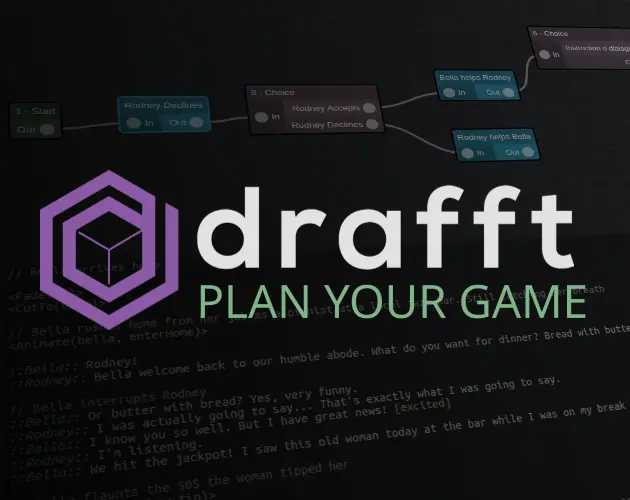
As your project and ambition grow, so too does the headache of managing the tangled mess of dialogue. For larger-scale projects, that sometimes means dealing with thousands of lines of text and hundreds of dialogue choices. That’s where Drafft comes in. Drafft is designed specifically with game writers in mind. It streamlines dialogue creation with a non-linear dialogue editor, an advanced scripting system, a powerful GDD (Game Design Document) editor, and more.

Below, we explore how Drafft’s game-changing features make writing, organizing, and implementing dialogue easier.

Breaking Free from Traditional Tools: A Better Way to Write Game Dialogues

· 2 min read
Drafft
Drafft Team

If you've ever tried structuring conversations for a game, you know the struggle:

  • Raw JSON is a nightmare. Sure, it's structured, but debugging deeply nested dialogue trees quickly turns into a game of "Where did I miss that comma?"
  • Node-based editors can get out of hand. They’re great for visualization, but once you have more than a handful of choices, your screen turns into a chaotic web of tiny boxes.
  • Filling forms is frustrating. Some tools force you into rigid UI forms, making every dialogue entry a tedious process of clicking through endless fields.
  • Hardwired schemas can be limiting. If your tool requires a strict structure, adapting your writing style—or making last-minute tweaks—feels like fighting against the system rather than working with it.
  • Text-only formats can be overwhelming. Some approaches rely entirely on scripting dialogue in plain text, which can be powerful but quickly becomes cumbersome as complexity grows.